
Brand foundations and a Canva-powered design system for Modal Architecture
Modal Architecture · Property & Trades · Project (Foundation) · Brand Strategy / Visual Identity / Photography Direction / Digital & Web / Canva Brand Kit & Dynamic Templates / Marketing Collateral · 2023
Brand foundations and a Canva-powered design system for the architectural design practice now scaling high-performance, sustainable, lifestyle homes across seven New Zealand regions — built so the founder can produce the next on-brand proposal himself, in an afternoon.
2023
Project · Foundation engagement, single delivery year
7
NZ regions now served on the brand and digital foundation Obvious laid down
2
offices — Wellington (Te Aro) & Auckland (Parnell)
3–4 hr
proposal turnaround on the Canva-based methodology Obvious itself reported in the joint Canva case study
Since launching in 2021, Wellington-based Modal Architecture has fast acquired a respected reputation for client-first lifestyle architectural design across New Zealand.Waterford Press — February 2025 (third-party press attestation, included while we request a direct testimonial from Sam Hodgson)
Modal Architecture was founded in 2021 by Sam Hodgson, a Wellington-based architectural designer whose career began on the Southern Response Housing Initiative — the post-2011 programme that rebuilt earthquake-affected Christchurch homes — and ran through one of New Zealand’s largest multi-disciplinary practices, Wellington apartment design, a design-and-build start-up, and a medium-density housing firm. The work behind the work was there. The brand was not.
By early 2023, Modal had reached the point most strong founder-led practices hit: enough referral demand to outgrow a single-operator footprint, a clear point of view on residential architecture — high-performance, sustainable, lifestyle-led — and a market that had stopped reading the firm’s identity as a reflection of the work it was actually delivering. Obvious was engaged to lay the brand foundations: strategy, identity, photography direction, marketing collateral, the new website, and a Canva-powered design system that would let Sam keep producing on-brand proposals, presentation decks and project documents at the speed an architecture practice actually runs at.
The brief
In residential architecture, the brand is the first conversation. Most New Zealand homeowners commissioning a new build or significant renovation will short-list two or three practices before they pick up the phone. That short-list is almost always made on the website, the Instagram, the Archipro profile, the booklet handed at the first site meeting. Modal’s work was already strong enough to win those decisions. The presentation was holding it back.
The brand had to be built for the firm Modal was becoming, not the one it had started as — the practice that would open a second Auckland office, run an active project list across seven regions, and report a noticeable mid-2024 surge in enquiries. The brief, in our shorthand: build a brand that earns trust the moment a homeowner lands on the page, holds up alongside the building partners and consultants Modal works with, and — the part most agency engagements quietly skip — gives a small, talented team a toolkit they could actually use, without an agency in the middle, as the practice expanded.
The strategy
We ran the engagement through Obvious’s 3×P framework — Proposition, Positioning, Proof. Modal had all three but only one was visible. The proposition was clear from the work itself: high-performance, sustainable, lifestyle homes, designed one-on-one with the client. The positioning was the harder part to make legible — in a category where every practice claims a style or a credential, Modal had to be readable as the science-led, client-first option without either over-claiming or under-selling. And the proof existed in the projects, the building-partner network, the smooth multi-council consent track record, and the affiliations — Passive House New Zealand, NZGBC, LBP — that signalled the high-performance commitment to anyone who knew to look.
We’re not just designing your home, we’re bringing some science to it.Sam Hodgson — Founder, Modal Architecture (as quoted in Waterford Press, Feb 2025)
The positioning shaped every design decision that followed. The identity needed to feel rigorous without ever feeling cold — high-performance is a science story, but residential architecture is also an emotional one. The photography needed to show liveable, lit, lived-in spaces alongside the architectural moments. The website needed to convert a stressed homeowner contemplating a million-dollar decision, not just impress a peer. We held to a single editorial principle through the rest of the work: quiet confidence. Modal does not need to shout. The work does the talking. The brand’s job is to give the work the room to be heard.
The work
Identity, photography, website and collateral, built as one system — with a single throughline: every asset had to be useable, on-brand, by a small team without an agency in the middle.
Wordmark & monogram
Drawn for the practice
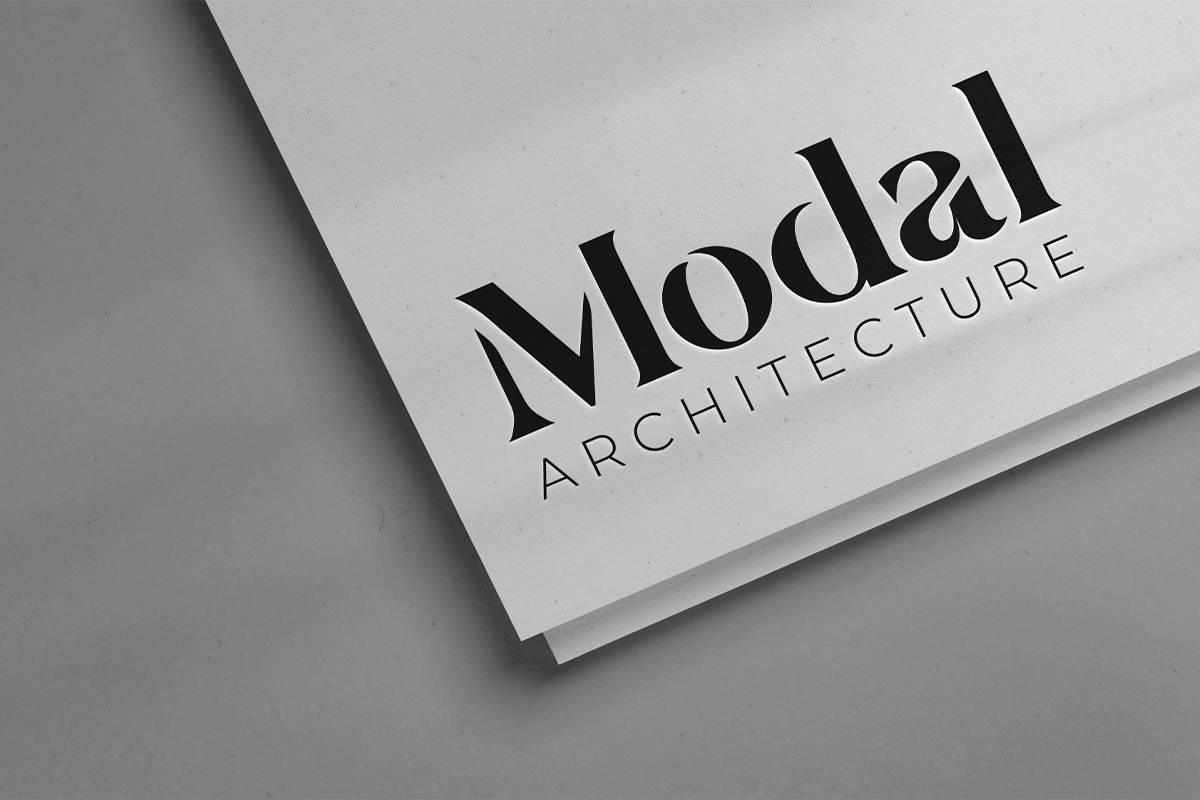
Custom-drawn serif wordmark sized to sit comfortably in a hero, on a business card, at favicon size, and on a project site sign. Complementary M monogram for square applications, social avatars, signage and small-format moments. Both marks drawn with a slight weight asymmetry that reads as confident rather than corporate.
Typographic system
Editorial weight, open-licensed
Paired type system selected to render cleanly across long-form project pages, scannable specifier collateral, captions and brochure headings. Open-licensed so the practice is never held hostage to a seat-licence renewal as the team grows, and chosen to render te reo Māori cleanly at every size.
Colour palette
Drawn from Aotearoa
Most architecture firms reach for black, white and one accent. Modal’s palette sits in a more grounded place — deep eucalyptus / sage green at the centre, supported by warm off-whites, soft creams and quiet blue gradients. Photographs well, prints well, holds character on a phone screen at the moment a homeowner is scrolling three practices side by side.
Photography direction
The home, not the building
Art-directed to sit between editorial and architectural — interiors with natural light and signs of life, exteriors that show the relationship between the building and its site, details that demonstrate craftsmanship without fetishising it. The image library continues to anchor the website and the collateral as the project list grows.
Printed brochure
The leave-behind
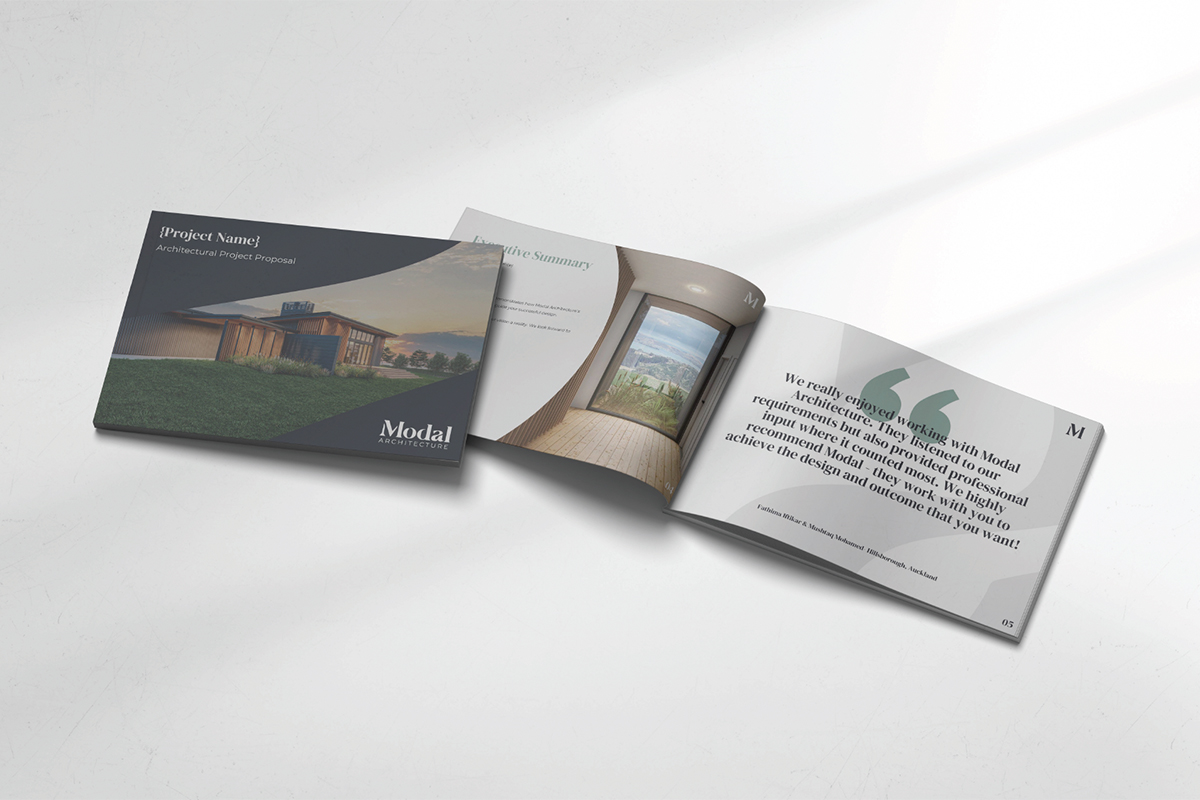
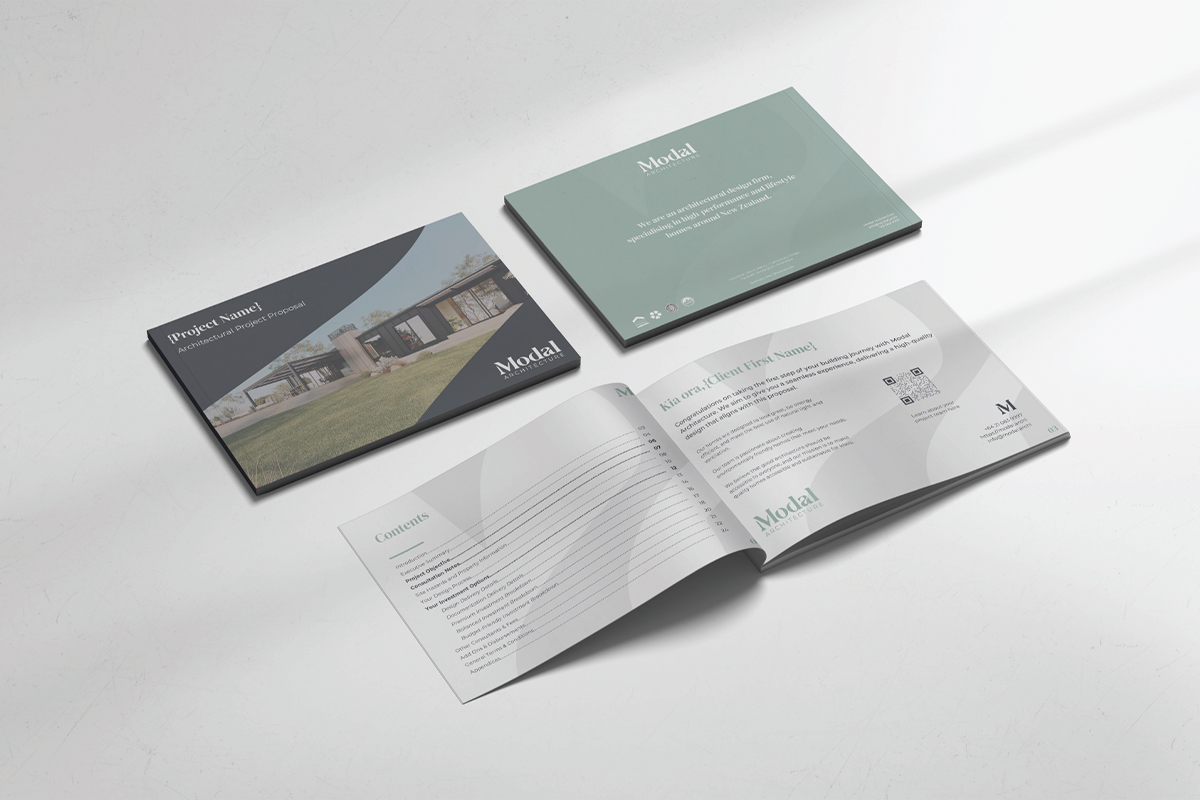
The single most important asset for a residential architecture practice is often the document the prospective client takes home from the first consultation. The Modal brochure was designed to print well, photograph well (one of the more shareable assets on the brand’s own Instagram), and read clearly at the end of a long day.
Website
Buyer journey, not portfolio scroll
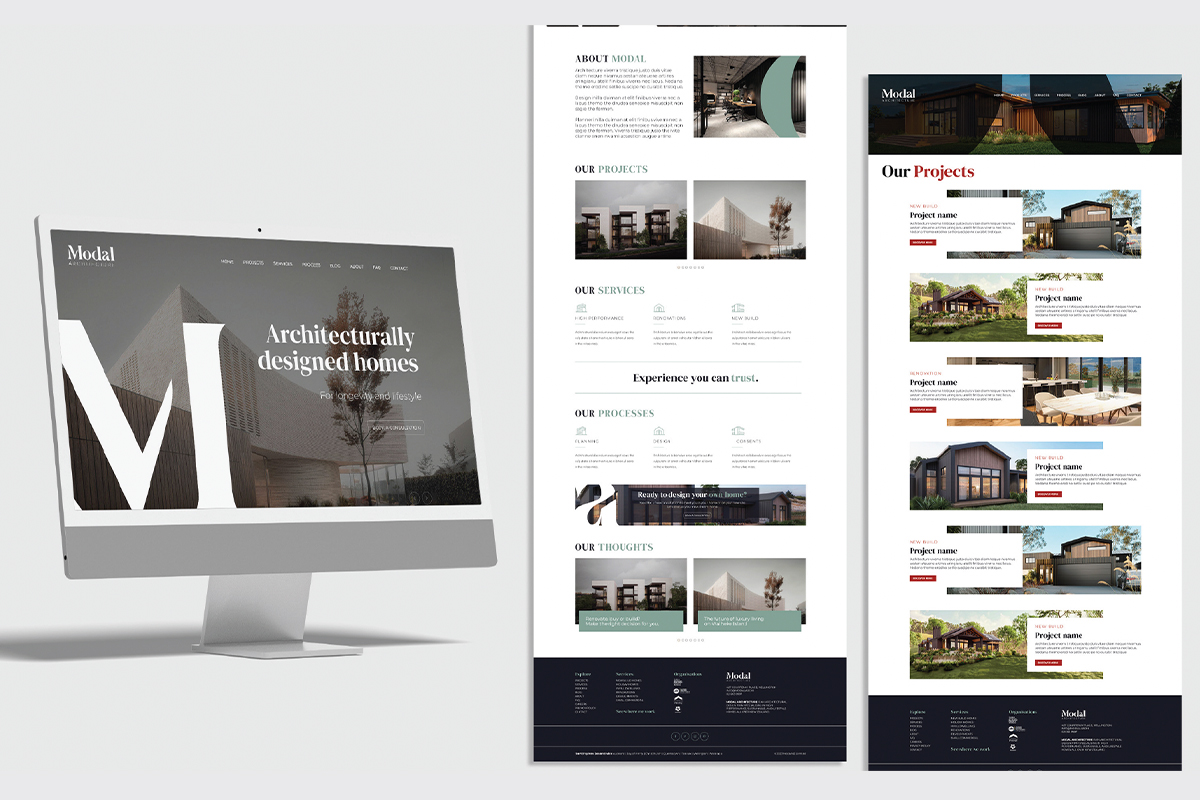
Built around a defined journey: a clear positioning paragraph above the fold, a project gallery that reads on mobile, a process page that demystifies what working with an architect actually looks like, regional pages for each market Modal serves, and a contact moment that lets a homeowner book a free consultation without an intermediate form-fill.
The Canva system
Most agency engagements end with a beautiful brand book and a final delivery email. The work then quietly comes apart in the eighteen months that follow, because the team it was built for has no way of producing the next proposal, the next pitch deck, the next project description, the next regional page, the next consent submission, the next Instagram carousel — without commissioning the agency again at agency rates, or doing it themselves off-brand in PowerPoint and Google Docs. That is the gap Obvious built the Canva system to close.
Why Canva, and why for Modal specifically
Obvious has been profiled by Canva (DR 93) as a case study in how an independent New Zealand brand and creative studio uses the platform inside a senior practice — “How Obvious Brand Partners empowers their clients and reduced turnaround time by 90%”. The methodology behind that case study is the methodology we built into the Modal engagement from day one: multi-seat without multi-licence-cost, print/web/social outputs from a single document, and brand integrity locked at the Kit level so colours, fonts and lock-ups update centrally as the brand evolves.
Featured in
Canva — How Obvious Brand Partners empowers their clients and reduced turnaround time by 90%. The joint Canva × Obvious case study documenting the Brand Kit and dynamic template methodology behind the Modal system.
The Modal Brand Kit
We set up a Modal Brand Kit inside Canva Teams with everything the visual identity work produced, version-controlled to one source of truth. Brand colours in HEX, RGB and Pantone. The custom wordmark and M monogram in every lock-up the practice would ever need — primary, secondary, single-colour, reversed, square, horizontal, vertical, social-avatar. The full typographic system with pairings pre-specified for headings, body, caption, project-information and table-stat applications. The brand photography library, tagged and searchable. The result: when Sam — or any of the architectural designers Modal has since added to the network — opens a new document, the brand is already loaded. Off-brand is harder than on-brand. That single inversion is the unlock.
The dynamic template library
The Brand Kit was paired with a dynamic template library covering every document type a residential architecture practice actually needs to produce in volume.
Proposal
The commercially-critical one
Architecture practices win work on the proposal. The Modal template drops into the Brand Kit and customises to a specific homeowner, site, brief and budget in under an hour — cover, founder introduction, design philosophy, process, project examples (pulled from the live image library), scope and fee summary, closing CTA. Leave-behind brochure, on-screen deck and emailable PDF all output from a single source. 3–4 day → 3–4 hour turnaround.
Presentation
The pitch deck
For pitching to a developer, presenting concept design to a homeowner, walking a building partner through a project, or speaking at a Passive House NZ event. Master slide layouts for cover, agenda, design narrative, drawings, materials, performance specifications and Q&A.
Project description
One source, every surface
Every project on the live modal.archi site has a structured project description that drops into the regional pages, the Archipro profile, Houzz, and the social posts that announce each new project. One template fills the content fields and outputs to all of those surfaces consistently.
Regional page
Seven regions, in-house
Modal services seven NZ regions: Auckland, Bay of Plenty, Christchurch, Queenstown, Taranaki, Wellington, Wairarapa. Each has its own page and its own occasional collateral. The template lets the team produce a region launch — brochure, social, email — to brand standard in a single afternoon.
Consent & council submission
The high-volume document
Less glamorous, but the document a residential architecture practice spends some of its highest-volume hours producing. Wraps the technical drawings and statutory content inside a Modal-branded cover, contents page and submission summary — so the document on a council planner’s desk reads as a professional firm, not a stack of CAD exports.
Social, signage & ops
The everyday extras
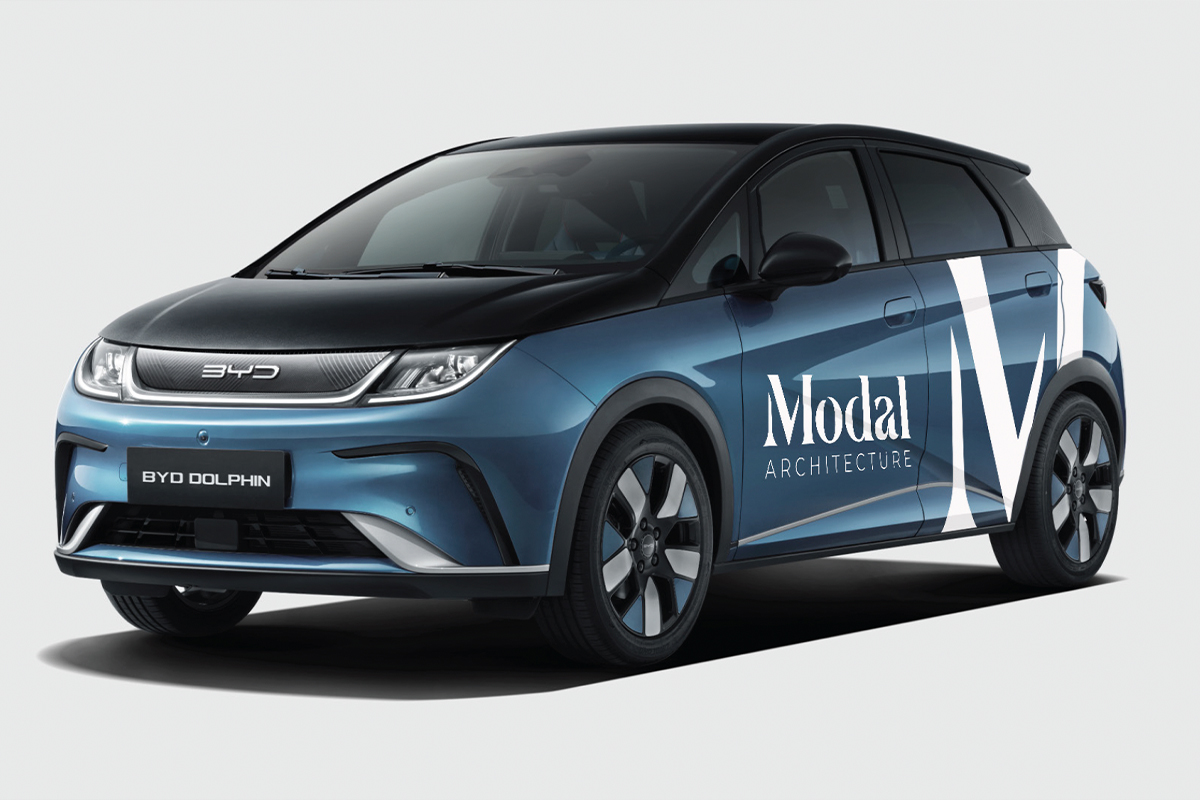
Instagram carousel and Story templates, email-signature lock-ups, business card and stationery, project signage for a build site, branded video-call backgrounds for the consultations Sam takes from Wellington with clients in Queenstown or Auckland.
The empowerment thesis
Brand integrity in a small, founder-led practice is determined by the friction between the brand standard and the moment-of-production. If producing an on-brand proposal takes three days and a designer, the founder cuts the corner. If it takes three hours and is editable by the founder, the brand standard holds across every piece of collateral that leaves the practice. The Canva Brand Kit and template library is the mechanism that closes that gap.
Outcomes — the firm Modal has grown into
We hold to a strict editorial discipline on this site: claim only what the evidence supports. Modal’s growth between the 2023 brand engagement and the present is not, in isolation, attributable to the brand work. A practice grows because the founder is talented, the work is good, the partners are trusted, and the market is moving. What brand foundation work does is make sure that growth is not blocked at the first impression — that the visible practice keeps pace with the actual one.
What is observable, on the public record, is the firm Modal has grown into since the 2023 engagement.
In a February 2025 feature in Waterford Press, Sam reported that “Modal Architecture is currently enjoying a good influx of work, with enquiries having noticeably increased from the middle of 2024,” and that the practice was “pleased with how well we’re going so far in 2025, with a number of clients being referred to us from our trusted building partners.” The same feature described Modal as having “fast acquired a respected reputation for client-first lifestyle architectural design across New Zealand” — language we did not write, but which sits comfortably alongside the positioning the brand was built to support.
By late 2025, the firm was operating from a second office at 125 St Georges Bay Rd, Parnell in Auckland, alongside the original Wellington studio at 43 Cuba St in Te Aro. The website was running active regional pages for Auckland, Bay of Plenty, Christchurch, Queenstown, Taranaki, Wellington and the Wairarapa. The published project list spanned new builds, renovations, infill dwellings, holiday homes, developments and small commercial work across the North and South Islands — from a Waikanae Beach seaside escape and a Karori infill dwelling to a Queenstown lifestyle home, a Marlborough off-grid build, a Coromandel apartment block and a Glenfield ridgeline home. Six attributed client testimonials sit on the live site, including one from the team behind Aro Digital — Obvious’s Paradigm sister agency — recounting an office redesign that “inevitably [ended up] being featured on WellingtonNZ’s coolest offices blog.”
Modal’s industry affiliations have stayed in step with the high-performance positioning the brand was built around: Licensed Building Practitioner status, a Passive House New Zealand directory listing, a New Zealand Green Building Council member profile, and an active Archipro presence. None of that is because of the brand. But the brand is the surface across which a homeowner, a building partner, a journalist, a directory editor and a referral source encounters Modal — and the practice has done its growing on top of the surface the 2023 engagement laid down.
Two specific things sit inside that growth that the Canva system was directly designed to enable. First, proposal velocity. When Waterford Press reported in February 2025 that enquiries had noticeably increased from the middle of 2024, the practice had the operational capacity to convert those enquiries because the proposal template — the most commercially important document in the firm — had been engineered down to a 3–4 hour turnaround. More enquiries are only an opportunity if the founder can get the proposals out fast enough to catch them. Second, multi-region capacity. Modal’s seven regional pages, the Auckland office launch, and the collateral that travels with each new project across the country have all been produced in-house, in Modal’s voice, by a small team using the templates Obvious left behind. A practice that had to commission an agency for each regional rollout would have rolled out more slowly. The system was the multiplier.
Why the work mattered
One — empowerment is the highest-leverage deliverable in a founder-led engagement. The wordmark, the palette, the photography direction and the website all matter. But the single piece of the engagement that has scaled with Modal at the speed Modal has actually scaled is the Canva Brand Kit and dynamic template system. A practice that wins on the proposal cannot afford to be locked into agency-paced turnaround.
Two — architecture is a brand-led category, even when no-one admits it. The buyer’s decision is made on trust, taste and short-list mechanics that often happen before a single conversation. A practice that wants to be considered alongside the best in the country has to look like one of the best in the country from the first surface a homeowner encounters.
Three — quiet confidence compounds, but only when the system holds it. Two and a half years after launch, the brand still feels like Modal’s, because the team can produce on-brand work at the speed the market moves. Brand investment that does not survive contact with the founder’s calendar gets diluted in eighteen months. The Modal system was specifically built to survive that contact, and so far it has.
Frequently asked questions
What does a brand foundation engagement for an architecture firm include?
For a founder-led architecture practice like Modal, a Project · Foundation engagement with Obvious typically covers brand strategy and positioning (via the 3×P framework), visual identity (wordmark, monogram, typographic system, palette), photography direction, the website, a printed leave-behind brochure, and a Canva Brand Kit and dynamic template library covering proposals, presentations, project descriptions, regional pages, consent submissions and social. The Canva system is the part that determines whether the brand investment compounds or decays after launch.
Why use Canva for an architecture firm specifically?
Three reasons. Multi-seat without multi-licence-cost — every team member edits on-brand without a per-seat Adobe bill. Print, web and social outputs from a single document — the proposal that needs to live as a PDF, a printed leave-behind, a presented deck and an emailable link in the same week. And brand integrity locked at the Kit level — colours, fonts and lock-ups version-controlled centrally. Obvious is profiled by Canva itself for the methodology, and the methodology was built into the Modal engagement from day one.
How long does a brand foundation engagement like Modal’s take?
Six to nine months is a realistic window for a founder-led practice at Modal’s stage — workshop and discovery, identity rounds, photography direction, website build, and Canva template library populated and trained. The shorter the timeline, the more often the Canva handover system gets cut for time — precisely the deliverable that determines how the brand holds together in the eighteen months after launch.
What does an Obvious brand foundation engagement cost?
Obvious publishes engagement pricing. Strategic Projects start at $7,995 and scale through $14,995 and $24,995+ depending on tier and scope. A founder-led architecture or design firm in Modal’s shape is typically a Project · Foundation engagement, sitting in the middle of that range. The most accurate read is a 30-minute conversation — start one here.
Does Obvious work with architecture practices outside Wellington?
Yes. Modal services seven NZ regions from offices in Wellington and Auckland. Obvious has worked with brands operating nationally and from each main centre, including remote-first engagements that mirror the way a modern architecture practice runs — Wellington studio with site visits from Northland to Queenstown. The Canva-powered handover toolkit is specifically designed to keep brand integrity in remote-first, multi-location practices.
Press
Waterford Press, February 2025 — Modal Architecture’s approach advocates high-performance design. Featured profile of Modal’s high-performance design philosophy and the mid-2024 growth in enquiries that has carried into 2025.
Building a brand for an architecture, design or trades practice?
If you’re a founder-led architecture or design firm, a property or construction business, or a professional services practice in the property and trades sector — one whose work has outgrown the brand carrying it, and whose team is small enough that the next proposal has to leave the founder’s keyboard fast — we’d love to talk. The Canva-powered design system is part of every Obvious foundation engagement, not a bolt-on.
Talk to us about a project · Talk to us about a partnership · Or just have a conversation
Visit Modal in the wild at modal.archi.


