
Brand partner for Orbit World Travel
Orbit World Travel · Kiwi-Owned Corporate Travel · Brand Partnership / Sub-Brand Architecture / Pitch & Tender Communications / Sales Enablement / Internal Comms / Motion & Voiceover · 2021 — Present
Helping a Kiwi-owned travel business punch above its weight — brand stewardship, pitch and tender craft, and sales-enablement creative for Orbit World Travel, New Zealand and Australia’s leading independent corporate travel management company.
2021→
brand partnership stewarding the master Orbit brand and family
4 yrs
Best Corporate Brand Multi-Location, National Travel Industry Awards (2016–2019)
AoG since 2012
All-of-Government Travel Management Services supplier
90+ countries
ALTOUR global network reach through Orbit
Obvious have been our brand and creative partner across some of the most important pieces of work we’ve delivered. They understand corporate travel, they understand procurement, and they understand how to take a Kiwi-owned business into the room against the multinationals and make sure we sound like the smart choice. They’ve become an extension of our team.Orbit World Travel
Orbit World Travel is New Zealand and Australia’s leading independent corporate travel management company. Owner-operated, partnered with House of Travel (Aotearoa’s largest travel group) and connected globally through the ALTOUR network of agencies in more than 90 countries — Orbit manages corporate, group, conferencing, school, sports, and incentive travel programmes for organisations across the country. They’ve been a long-standing All-of-Government Travel Management Services supplier and have been named Best Corporate Brand Multi-Location at the National Travel Industry Awards four years running (2016, 2017, 2018, 2019).
That’s the credentials list. The business challenge is harder. Corporate travel management is a category where global multinationals arrive with global tooling, global procurement frameworks, and global creative resource. A locally-owned, owner-operated New Zealand business has a better story to tell — closer relationships, faster decisions, deeper local knowledge, real skin in the game — but only if that story is told as well as the multinationals tell theirs.
From 2021 onwards, Orbit appointed Obvious as their brand partner — supporting and stewarding the master Orbit brand, and leading the creative work behind the things that move the business: pitch and tender communications, sales enablement, sub-brand and adjacent-business identity work, and the internal communications systems a national B2B operation runs on. Orbit’s clients are private B2B and public-sector buyers — not consumers — and the focus of our work has reflected that throughout.
Chapter 1: Brand stewardship and the family beneath it
Maintaining the master brand. Building the businesses around it.
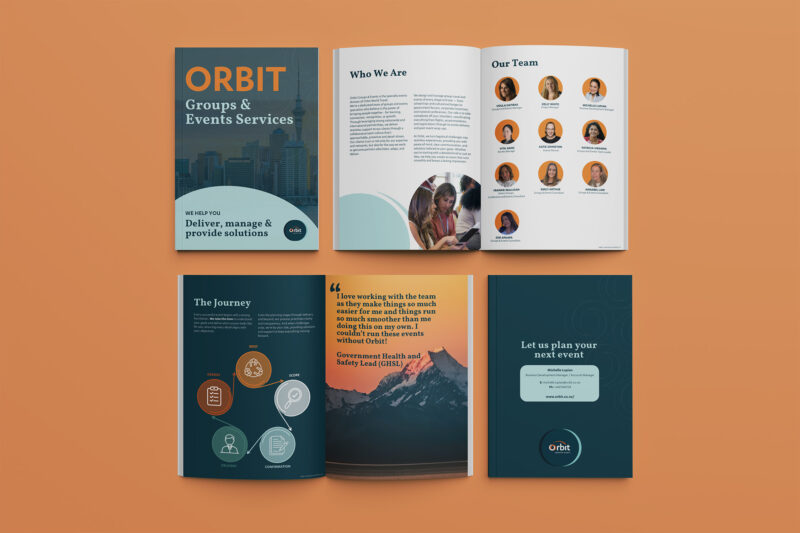
We didn’t create the Orbit master brand — that identity sits at the heart of a national operation that’s been earning its place for years. Our role from day one was to steward that brand, discipline its application, and develop the family of identities and communications systems that sit alongside it.
The engagement opened with a Brand Discovery Workshop — a structured day with Orbit’s leadership team focused on the brand architecture: where the master Orbit brand sits, what the supporting brands and adjacent businesses need to do, and how the system needs to flex across pitch, internal and external touchpoints.
From that foundation we developed:
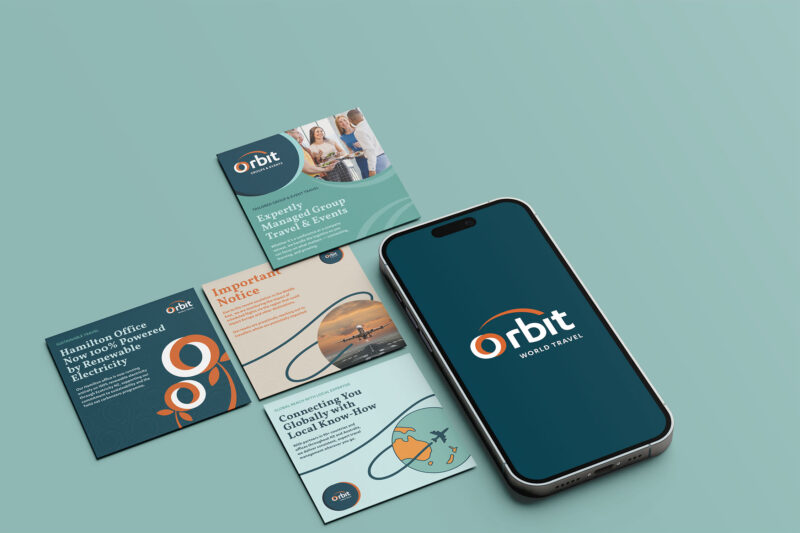
- A clarified brand architecture for the family of businesses sitting beneath and alongside the master Orbit brand — including the development of Attend NZ, the conferencing and events sub-brand, taken from naming and wordmark concepts through to identity application
- Naming workshops for new propositions, sub-brands and product extensions
- Brand-system extensions and templates that sit on top of Orbit’s existing master identity — colour discipline, typographic application, photography direction, lockups, and the downloadable templates the marketing and account teams use every week
- Strategy and identity work for new commercial propositions, adjacent businesses and internal communications — the kind of work that lets a national group step into adjacent markets without diluting the centre
Brand work is only worth as much as the work it goes on to inform. Everything that follows in this case study sits on that foundation.
Chapter 2: Pitches and tenders, told well
The communications craft behind the deals that move the business.
This is the centre of the appointment. In corporate travel management, the deals that change the trajectory of a business are large institutional accounts — private B2B and public-sector buyers running structured procurement processes. They’re won less on price than on trust: on whether the procurement panel, on the day they read the document, believes this provider understands the scale, the duty-of-care obligations, and the cultural specificity of the job.
Across the engagement we’ve led the communications craft of pitching at that level:
- Bespoke pitch documents for category-defining accounts — leading the strategic narrative, document design, and presentation system, and translating Orbit’s existing credentials, sustainability reporting, and duty-of-care infrastructure into language a senior procurement audience can act on
- A reusable master pitch system — a designed presentation framework so every Orbit submission walks into the room looking and reading like a unified, premium operator
- All-of-Government communications support — Orbit has been on the AoG Travel Management Services panel since 2012, and we’ve supported the strategic communications around panel positioning across the relationship
- Sector-specific positioning — adjusting tone, document architecture and proof points so the same underlying credentials read fluently to buyers across very different parts of the public and private sector
Pitching for the largest institutional contracts in Aotearoa is a craft. We’ve made it part of ours.
Specific named accounts and pursuits are deliberately omitted from this case study to respect the commercial sensitivity of Orbit’s pitches. Happy to talk about the work in more detail in a private conversation.
Chapter 3: Sales enablement for a SaaS-adjacent travel platform
Turning a category-leading booking tool into a story buyers can hear.
Orbit’s online booking offer is one of the strongest technology stacks in the New Zealand market — combining a next-generation booking platform with a global GDS, layered with business analytics, mobile control, and duty-of-care reporting. On paper it’s a category-leading product. The question — like every B2B technology pitch — was how to make the demo land in twelve minutes inside a procurement evaluation room.
We built Orbit’s sales-enablement creative system around the booking tool:
- An RFP booking-tool video — a tightly scripted, motion-led product walkthrough designed to drop into pitch decks, supplier portals, and procurement evaluations. We wrote the script, directed the motion, and delivered the file as a portable asset that survives every future tender.
- Custom voiceover production for the booking-tool video and supporting AV — recorded and produced through our own audio process, delivered as polished masters and broadcast-ready exports
- Reporting and analytics communications — visual system, screen designs and explanatory collateral for Orbit’s business-analytics product
- Briefing and document templates so account teams can write, build and deliver new pitch material that looks system-native — without going back to design for every iteration
The result is that an Orbit account director can walk into a competitive pitch and demonstrate the product with the same fluency a global SaaS rep would expect. That parity matters.
Chapter 4: Brand stewardship and internal communications
The work between the pitches.
Our brand-partner appointment isn’t a public marketing rhythm — Orbit’s audience is private B2B and public-sector procurement teams, not a consumer market. The work between the major pitches is the kind of stewardship and internal communications that holds a national operation together:
- Internal communications systems — presentation templates, leadership comms, account-team briefing systems, and the document scaffolding that keeps national teams aligned across multiple offices
- Brand stewardship — ongoing discipline and application of the master Orbit identity across the moments that matter to the business, plus active management of the adjacent-brand family
- Strategic positioning for individual offices and propositions when a regional or sector context requires its own narrative inside the broader brand
- Community and sponsorship comms — supporting brand-aligned creative for Orbit’s national philanthropic programme and the not-for-profit and community organisations Orbit publicly partners with
The result, five years in, is a denser brand system, sharper templates, and a faster response time on the pitch and tender work that actually moves the commercial dial.
Why the work matters
Three things we believe B2B service brands should do.
One — make the buyer’s job easier. Procurement panels and evaluators don’t owe you the benefit of the doubt. Every document, video, and pitch has to do the work of compressing a complicated service into something a panel can read in twenty minutes and trust in five. That’s a creative problem before it’s a sales problem.
Two — earn the right to be the local choice. The strongest argument a Kiwi-owned business has against the multinationals is that the relationship is closer, the decisions faster, and the cultural fluency real. Brand work either earns the right to make that argument or it doesn’t. Owner-operated, ALTOUR-connected, AoG-credentialed — the proof points are there; the brand has to surface them.
Three — build for the long game. A pitch deck wins one tender. A brand system wins the next decade of them. Our brief with Orbit has always been the second one.
Outcomes
What this enables for Orbit World Travel
- Brand stewardship across the master Orbit identity and the family of sub-brands. Including the development of Attend NZ, the conferencing and events sub-brand, from naming and wordmark concepts through to identity application.
- A reusable master pitch system that punches above its weight. A designed presentation framework so every Orbit submission walks into the room looking and reading like a unified, premium operator against global multinationals.
- A sales-enablement video that drops into every future tender. RFP booking-tool walkthrough — scripted, motion-directed, voiceover-produced, delivered as a portable asset that survives every future submission.
- Internal comms scaffolding for a national operation. Presentation templates, leadership comms, account-team briefing systems and the document scaffolding that keeps national teams aligned across multiple offices.
Running a Kiwi-owned B2B service business?
If you run a New Zealand B2B service brand — corporate travel, professional services, tech, infrastructure, healthcare, education, or any sector where you compete with global players for institutional and public-sector accounts — and you’re looking for a brand partner who can support your existing identity, develop the businesses and sub-brands around it, and lead the creative craft of pitch and tender communications, we’d love to talk. See Orbit’s work in the wild at orbit.co.nz.

